China Brands × North America: The Market Landing Map (v2, Fall 2026)
85 Chinese brands mapped by how deeply they have landed in North America: shelf, store, team, factory. Cheap trust is gone; landing depth is trust made physical. The most underpriced square on the map is Canada. Updated quarterly.

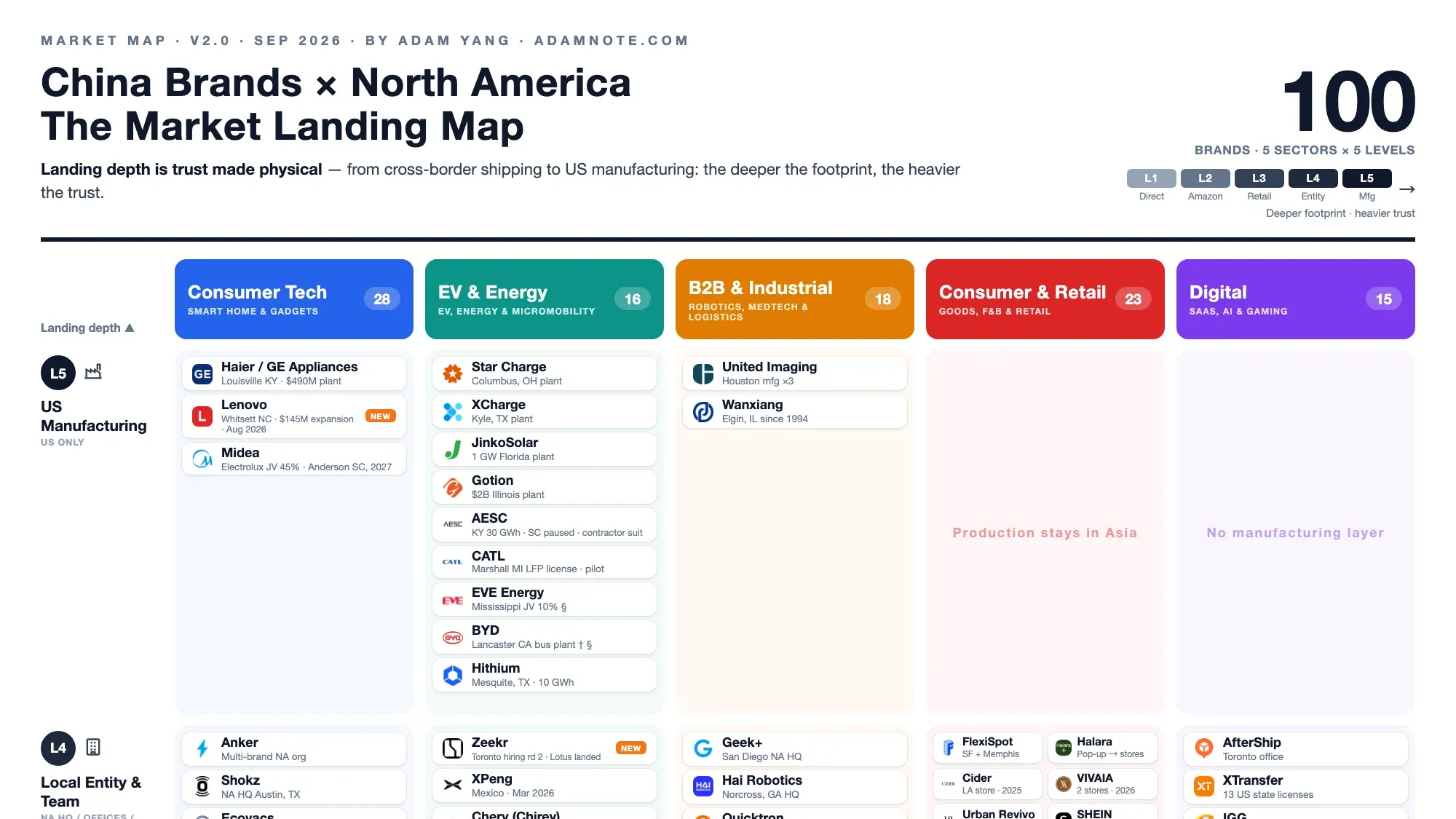
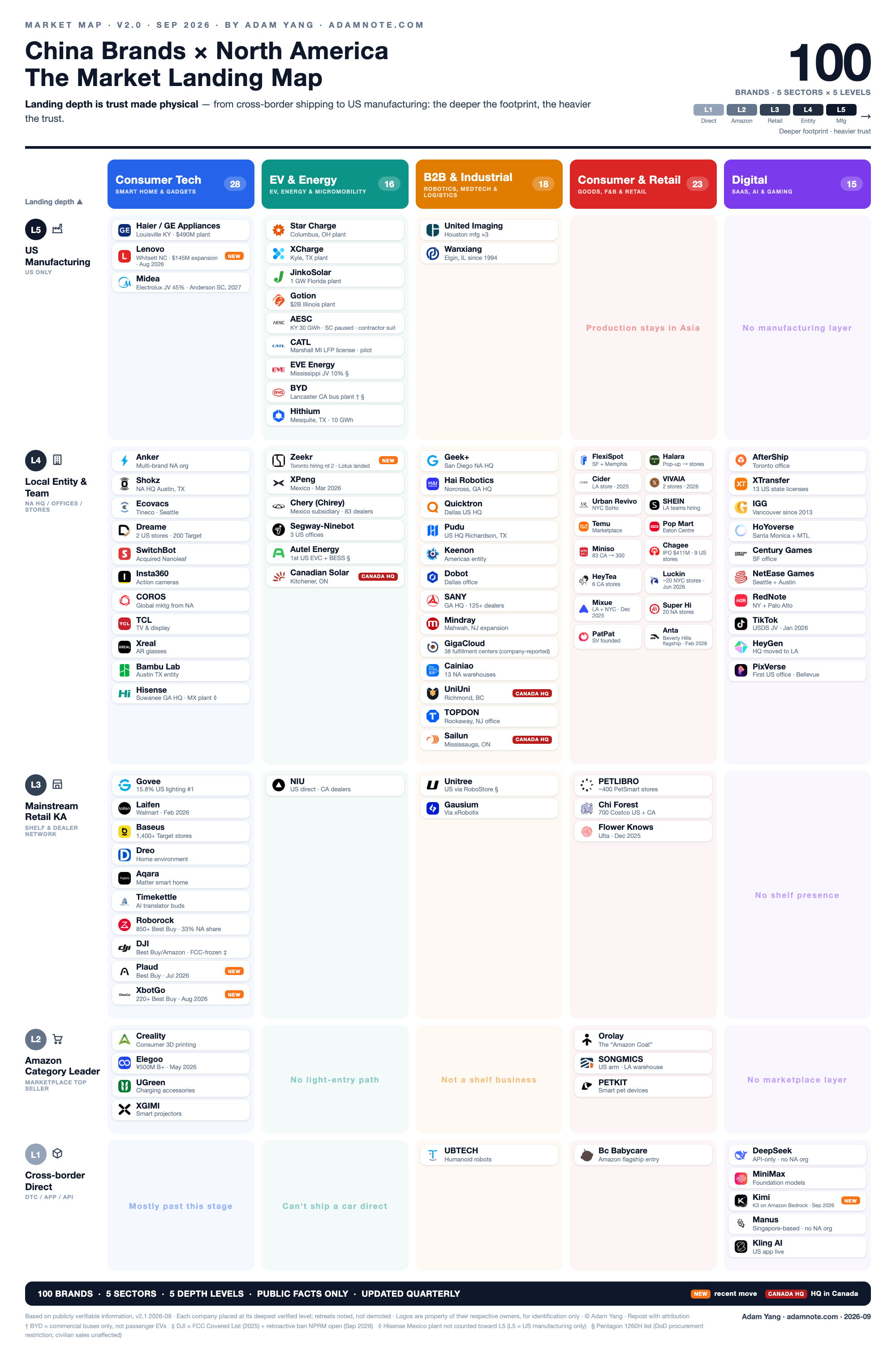
100 Chinese brands and companies, plotted on one chart by landing depth × sector. Every placement is backed by a specific, publicly verifiable fact — a retail channel, a store, a headquarters, a factory — not an impression. Data as of September 2026, updated quarterly.
For ten years, the standard question about Chinese brands abroad was “how are sales?” Revenue, rankings, growth rates. In North America in 2026, that question no longer tells you much. The better question is: how deep is the landing?
Whether a company ships parcels across the Pacific or pours concrete in Ohio is not a detail. It is the whole story. Because the thing Chinese brands used to buy cheaply, a customer’s first act of trust, has gotten expensive. Tariffs and the end of de minimis ate the price advantage. Amazon reviews stopped converting mainstream skeptics. What’s left is the slow way: put something physical where the customer can see it. A shelf at Costco. A store in SoHo. A local team. A factory.
That’s the thesis of this map: landing depth is trust made physical.
The framework
Columns: five sectors. Consumer tech & smart home · EV/energy · B2B/industrial · consumer goods, F&B & retail · digital/SaaS/gaming.
Rows: five levels of landing depth. Each company sits at the deepest level it has verifiably reached.
| Level | Meaning | Evidence looks like |
|---|---|---|
| L1 Cross-border Direct | Online cross-border, DTC, apps, or project exports; no local organization | Standalone site, app, API, dealer orders |
| L2 Amazon Category Leader | Top of an online category; maybe self-run warehouses; organization still in China | Amazon BSR leadership, own overseas fulfillment |
| L3 Mainstream Retail KA | On mainstream physical shelves or running a dealer network | Walmart / Costco / Target / Best Buy / Ulta / PetSmart / dealers |
| L4 Local Entity & Team | North American HQ, offices, own stores, distribution centers, local executives | NA HQ, direct retail, local hiring |
| L5 US Manufacturing | US factories, JVs, or technology licensing to US producers | US plants, JVs, licensing deals |
L5 = US manufacturing only. Mexico is deliberately excluded. Many Chinese brands run Mexican contract/OEM plants, so counting Mexico would pull in dozens of names and dilute what L5 is meant to signal: the deepest, most capital- and politics-heavy commitment — a plant on US soil.
The map (100 companies)
| Depth | Consumer Tech & Smart Home | EV, Energy & Micromobility | B2B, Industrial & Logistics | Consumer Goods, F&B & Retail | Digital, SaaS & Gaming |
|---|---|---|---|---|---|
| L1 Cross-border Direct | — | — | UBTECH | Bc Babycare | DeepSeek · MiniMax · Kimi · Manus · Kling AI |
| L2 Amazon Category Leader | Creality · Elegoo · UGREEN · XGIMI | — | — | Orolay · SONGMICS · PETKIT | — |
| L3 Mainstream Retail KA | Govee · Laifen · Baseus · Dreo · Aqara · Timekettle · Roborock · DJI‡ · Plaud · XbotGo | NIU | Unitree§ · Gausium | PETLIBRO · Chi Forest · Flower Knows | — |
| L4 Local Entity & Team | Anker · Shokz · Ecovacs/Tineco · Dreame · SwitchBot · Insta360 · COROS · TCL · Xreal · Bambu Lab · Hisense◊ | Zeekr Intl (Geely) · XPeng · Chery (Chirey) · Segway-Ninebot · Autel Energy§ · Canadian Solar* | Geek+ · Hai Robotics · Quicktron · Pudu · Keenon · Dobot · SANY · Mindray · GigaCloud · Cainiao · UniUni* · TOPDON · Sailun | FlexiSpot · Halara · Cider · VIVAIA · Urban Revivo · SHEIN · Temu · Pop Mart · Miniso · Chagee · HeyTea · Luckin · Mixue · Super Hi (Haidilao) · PatPat · Anta | AfterShip · XTransfer · IGG · HoYoverse · Century Games · NetEase Games · RedNote · TikTok · HeyGen · PixVerse |
| L5 US Manufacturing | Haier / GE Appliances · Lenovo · Midea (JV) | Star Charge · XCharge · JinkoSolar · Gotion · AESC · CATL (licensing) · EVE Energy (JV)§ · Hithium · BYD†§ | United Imaging · Wanxiang | — | — |
* China–Canada hybrid entities (Canadian-registered, deeply tied to Chinese supply chains or capital), included as “bridge” cases. † BYD’s US manufacturing is commercial vehicles only — an electric-bus plant in Lancaster, CA. BYD passenger EVs are not sold in the US market. ‡ DJI’s mainstream-retail landing is real but regulatorily frozen: it was added to the FCC Covered List (Dec 2025), blocking new equipment authorizations, so new units are largely unavailable at US retail. The FCC has also proposed a retroactive ban on previously authorized models; comments closed September 2, 2026, and as of September 2026 it remains a proposal, not a decision. ◊ Hisense is placed at L4 (Hisense USA HQ in Suwanee, GA + national retail at Best Buy / Lowe’s / Walmart / Costco). Its largest TV plant is in Rosarito, Mexico — not counted at L5, since L5 here is US manufacturing only. § Added to the Pentagon’s Section 1260H list (“Chinese military companies”) on June 8, 2026: BYD, EVE Energy, Unitree, and Autel Energy’s parent company Autel Intelligent Technology. The effect is a US defense-procurement restriction; civilian sales are unaffected. Positions on the map are unchanged, annotated.
v1.1 (2026-07) added Midea, Haier / GE Appliances, BYD, Lenovo, Hisense, Bambu Lab, Roborock, and DJI — the names flagged as unfinished evidence chains in v1 are now placed. v1.2 (2026-07-23) added Chery: its Mexican subsidiary Chirey Motor México (running Chery, Omoda, and Jaecoo through 83 dealers, with a DHL-operated 10,000+ m² central parts warehouse) was an existing landing this map had undercounted. No local factory; sales are in a consolidation phase. v2 (2026-09) adds four companies: Hithium (battery plant in Texas in volume production, EV L5), Plaud (into Best Buy, consumer tech L3), XbotGo (220+ Best Buy stores, consumer tech L3), and Anta (first US flagship in Beverly Hills, consumer goods L4), taking the map from 94 to 98. Midea moves from L4 to L5: Electrolux turned its Anderson, South Carolina plant into a joint venture with Midea holding 45%. One correction: the Ford plant that CATL licenses its LFP technology to is in Marshall, Michigan, not Kentucky. BYD, EVE Energy, Unitree, and Autel Energy carry a new § footnote. Plaud and XbotGo are included under a “born global” rule: US-registered entities whose R&D or supply chain sits in China. Country of origin here follows the team and the supply chain, not the registration. v2.1 (2026-09-29) adds three and removes one: Kimi (K3 generally available on Amazon Bedrock since Sep 18, digital L1), PixVerse (first US office in Bellevue, digital L4), and Manus (independent again as a Singapore company after separating from Meta, digital L1). Immersive Translate is removed: its business is small, and many similar companies would qualify on the same basis. The map now covers 100 companies.
What the map shows: everything is moving deeper
Line up 100 companies by landing depth and something appears that no single news item shows: the whole chart is shifting toward depth. Not one company’s choice; a generation of companies moving at once. Three patterns stand out.
1. The Amazon champion’s rite of passage
Between 2024 and 2026, Chinese brands that own the top of an Amazon category walked into mainstream retail almost in single file. Laifen’s hair dryer hit Walmart shelves in February 2026 at $79.97. Baseus entered 1,400+ Target stores in October 2024. PETLIBRO put its AI litter box into nearly 400 PetSmart stores in March 2026. Flower Knows became one of the first Chinese color-cosmetics brands in Ulta in December 2025. Chi Forest (Genki Forest) reached 591 Costco warehouses in the US plus 109 in Canada. This quarter added two more names to the same shelf: Plaud’s AI recorder went into Best Buy in July, and XbotGo’s AI sports camera into 220+ Best Buy stores in August.
The most telling case is Govee. North America is 83% of its revenue and it leads US smart ambient lighting at 15.8% share. Yet its IPO prospectus brags about cutting Amazon dependency from 76.6% to 65.6%. When the #1 player in a category treats leaving its home platform as an achievement, that tells you something: being an Amazon category champion is a ceiling, not a destination. Traffic costs keep rising and brand premium doesn’t follow. Meanwhile a Walmart or Costco shelf is the default trust list of the ordinary American household. Vendor onboarding, channel compliance, returns terms, local support — the annoyances are the moat. Whoever survives them first stops being a seller and starts being a brand.
2. DTC stopped pretending
The DTC story used to be that physical retail was the old world, waiting to be disrupted. Since 2025, the disruptors have been signing leases. Halara ran pop-ups in LA and Palo Alto and announced plans for flagship stores. Cider opened its first permanent store in LA (about 8,000 sq ft), with two more planned within the year. VIVAIA opened mall stores at Roosevelt Field and Garden State Plaza in spring 2026. Urban Revivo took 30,000 sq ft in SoHo, its largest store outside China. Anta, a sportswear brand rather than a DTC native, opened its first US flagship in Beverly Hills in February 2026 and called it the starting point for national expansion.
The math forced the pivot: customer acquisition costs, tariffs, and the tightening of de minimis broke the pure-online model. A store you can touch became trust you can touch.
3. Factories go to America. Distribution goes to Canada. And the Canada gap.
The energy and industrial companies show a remarkably consistent division of labor. Manufacturing concentrates in the US: Star Charge in Columbus, Ohio (plus a Fremont Americas HQ and a 32+ GWh storage MSA signed in November 2025), XCharge in Kyle, Texas, JinkoSolar in Jacksonville, Florida (1 GW capacity after a $52M expansion), Gotion’s $2B plant in Manteno, Illinois, AESC’s 30 GWh plant in Bowling Green, Kentucky, Hithium’s 10 GWh battery plant in Mesquite, Texas, United Imaging manufacturing all four imaging modalities in Houston and more than tripling its floor space in Pearland. The drivers are no mystery: tariffs, the IRA, and “made in America” procurement preferences. The friction is real too: AESC’s South Carolina plant has been paused since June 2025, Gotion walked away from its Michigan project in October 2025, and CATL doesn’t build at all: its arrangement at Ford’s Marshall, Michigan plant is technology licensing, a workaround shaped entirely by politics. EVE Energy took the JV route in Mississippi with Cummins, Daimler Truck, and PACCAR, as a 10% technology partner; production is now pushed to 2028.
Canada plays a different role on this map, and for North American readers this is the part worth staring at. Canadian Solar runs its global headquarters from Kitchener, Ontario. Sailun runs its Americas arm out of Ontario with its own Canadian dealer network. SwitchBot acquired a controlling stake in Toronto’s Nanoleaf (per Matter Alpha) to get a North American retail distribution pipeline. Cainiao’s overseas warehouse network extends into Canada. UniUni, headquartered in Richmond, BC, runs last-mile delivery for SHEIN, Temu, and TikTok Shop across 80+ warehouses. HeyTea opened a Toronto distribution center in December 2025. Pop Mart announced a Toronto Eaton Centre store and at least ten more Canadian stores within the year. Miniso has 83 Canadian stores and targets 300 by 2030. Zeekr International spent April 2026 hiring an entire management team (sales, marketing, product) in Toronto to bring the Geely Auto brand into Canada, and ran a second hiring round in July.
Connect those dots, though, and the more striking thing is the blank space around them. For most Chinese companies, Canada is still something the US team covers on the side. The companies treating it as a market of its own — with its own organization and budget — can be counted on one hand. In a cycle where US policy risk keeps rising, that blank space is itself information. My read, and I’ll mark it as opinion: Canada is currently the most underpriced entry point on this map, and the handful of companies staffing it deliberately are early rather than wrong.
Why now
The three shifts share one underlying variable: cheap trust is gone. The first order bought with a low price is being eaten by tariffs and platform fees. Reviews accumulated online can’t carry brand recognition among mainstream buyers. So depth became the physical form of trust: a shelf is trust, a store is trust, a local team is trust, and a factory is the most expensive trust of all.
One honest caveat: this is the lens I use to read the map, not a law. Each company moved deeper for its own reasons — some ran the numbers, some were pushed by policy. The value of the lens is that it makes 100 isolated news events point the same direction. Whether the direction holds is what the next quarterly update is for.
This quarter (September 2026): one level-jump, and a band of regulation
A quarter passed and only one company already on the map changed position. The movement is concentrated in two places: the US-manufacturing row is investing more, and the regulatory footnote grew into a band.
The level-jump: Midea gets a US factory through a JV
In April 2026, Electrolux announced it would turn its Anderson, South Carolina plant into a joint venture: Electrolux 55%, Midea 45%, for an initial 15 years. The plant retools from refrigerators to laundry, closed temporarily in July, and is scheduled to restart in the first half of 2027.
By this map’s rule, a JV stake counts as US manufacturing. The precedent is EVE Energy: a 10% stake in a Mississippi JV that won’t produce until 2028, and it sits at L5. Midea moves from L4 to L5 on the same basis. It is the only level change this quarter.
Four new names
Hithium: a battery-storage plant in Mesquite, Texas, 10 GWh a year, shipping in volume since August 2025. Straight to L5. Plaud: AI voice recorders, in Best Buy since July 2026. XbotGo: AI sports cameras, in 220+ Best Buy stores since August 2026. Anta: first US flagship in Beverly Hills, February 2026; the company calls it the starting point for national expansion.
Plaud and XbotGo are US-registered companies with R&D or supply chains in China. Do “born global” companies count as Chinese brands? On this map, yes. Country of origin follows the team and the supply chain, not the registration.
US manufacturing is where the money moved
Only one company crossed a line, but the incumbents on the L5 row made the biggest moves. Lenovo announced a $145M expansion of its Whitsett, North Carolina plant in August, to 890,000 sq ft, retooled for AI servers. Ford’s Marshall, Michigan plant, built on CATL’s licensed LFP technology, began pilot cell production in June. Hithium’s Texas plant is in volume production. Midea took 45% of Anderson.
The four point the same way: under the current tariff regime, companies that already have a US plant are adding to it; companies that don’t are waiting.
Regulation: from one footnote to a band
In the last version, regulation was a single footnote on DJI. This quarter it is a band.
On June 8, the Pentagon updated its Section 1260H list, adding BYD, EVE Energy, Unitree, and Autel Energy’s parent company Autel Intelligent Technology. It restricts US defense procurement and does not touch civilian sales, so positions stay and a § footnote is added.
On July 28, the FCC brought foreign-made advanced robots under its Covered List: new models need approval, previously authorized ones can keep selling.
The proposed retroactive ban on DJI, which would revoke authorizations already granted, closed for comment on September 2. As of September it is still a proposal.
Read together: regulation is extending from “block new products” toward “reach back to old ones” and “restrict procurement.” So far, none of the three has removed a company’s civilian channel.
Exits and pauses
Meituan’s restaurant-software arm Peppr entered the US in 2025, piloting with several hundred restaurants in LA, Dallas, and Houston, and shut down all US operations on March 31, 2026 (per industry reporting). Less than a year in, with neither product nor organization localized, it is the quarter’s one clean exit. Peppr was never on the map and does not enter the matrix.
AESC’s South Carolina plant has been paused since June 2025; in July 2026 its general contractor sued for $26.2M, and AESC said it has invested over $1 billion and remains committed to the region. Gotion’s Manteno, Illinois plant is in production. A pause is not an exit: positions stay, annotated.
Canada: the door opened, the cars didn’t come
Canada’s import quota for China-made EVs started in March 2026. The first tranche of 24,500 vehicles used only 15,603, almost all of them Shanghai-built Teslas. As of September, none of Chery, Zeekr, or BYD is selling in Canada, and BYD’s Canadian dealer network has never been officially confirmed. Zeekr ran a second Toronto hiring round in July. The quota is in place; the sales organizations behind it are still being built.
How to read this map
Three rules:
- Position is a snapshot, not a ranking. L5 doesn’t beat L2. SONGMICS is thriving at L2; some L5 factories are paused. A position answers one question: how much has this company physically committed to North America right now?
- Each level up, organizational cost jumps an order of magnitude. L2→L3 takes channel compliance and retail BD. L3→L4 takes local hiring, local legal, local leadership. L4→L5 is capital expenditure plus political engineering. A large cluster of companies is stuck between L3 and L4: channel secured, organization lagging. That’s the highest-friction square on the map, and the most interesting one to watch.
- The blanks matter as much as the names. EV/energy has no L2 or L3: the sector offers no light-footprint option; you either stay out or go heavy. Digital products cluster at the extremes, L1 and L4: zero landing or full entity, almost nothing in between. Consumer goods and F&B have no L5 because the supply chain is still in Asia. Sector structure sets the shape of the path; companies only choose within it.
Data note: This map uses only publicly verifiable information — company announcements, listing documents, mainstream media reports, official channel pages. Company-sourced figures are labeled as such. Inclusion requires a verifiable North American landing action and a business of meaningful scale; absence from the map does not mean absence of business. v2.1 covers 100 companies with data as of September 2026, and will be updated quarterly. Corrections welcome.
Corrections welcome.
Corrections welcome.
FAQ
What is "landing depth"?
A five-level framework for how much a Chinese brand has physically committed to North America: L1 cross-border direct, L2 Amazon category leader, L3 mainstream retail, L4 local entity and team, L5 US manufacturing (US plants only). Each company sits at its deepest verified level.
Why is landing depth "trust made physical"?
Tariffs and platform fees ate the price advantage, and online reviews alone stopped converting mainstream buyers. A shelf, a store, a local team, or a factory is trust a customer can verify with their own eyes.
Which Chinese brands have entered mainstream US retail?
Between 2024 and 2026: Laifen into Walmart, Baseus into 1,400+ Target stores, PETLIBRO into nearly 400 PetSmart locations, Roborock into 850+ Best Buy stores, Flower Knows into Ulta, and Chi Forest into 591 US Costco warehouses.
What is the "Canada gap"?
Manufacturing concentrates in the US, while distribution and headquarters functions grow in Canada: Canadian Solar in Kitchener, Sailun in Mississauga, UniUni in Richmond, BC. Yet most companies still run Canada as a side task of their US team, with no dedicated organization or budget.
How is this map sourced and updated?
Only publicly verifiable information: company announcements, listing documents, mainstream media, official channel pages. Every placement maps to one specific fact. Updated quarterly; v2.1 covers 100 companies.