Same Question, Different Answers: How Chinese and Western AI See Chinese Brands (September 2026)
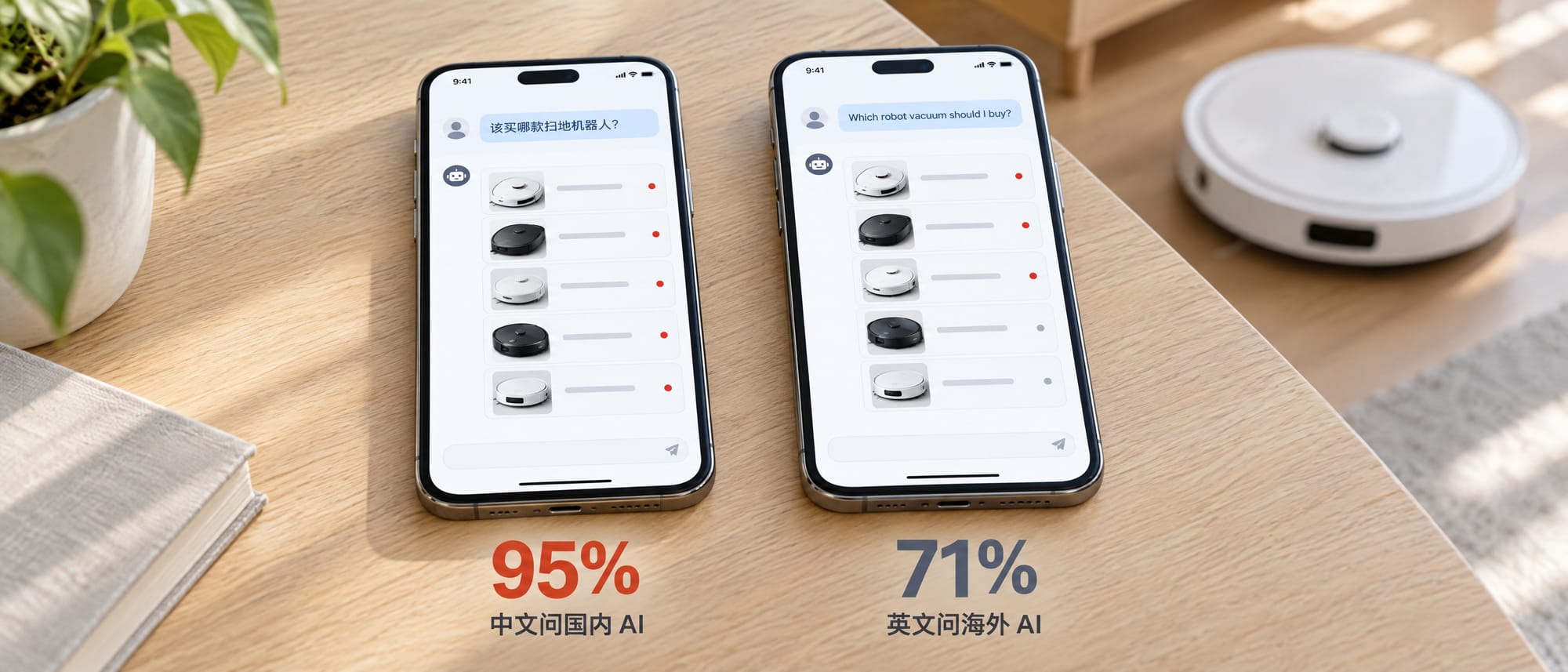
Ask the same shopping question in Chinese to Chinese AI and 95% of brand mentions are Chinese brands; in English to Western AI, 71%. 10 categories, 11,685 AI answers.

🌍 中文版:海外 AI 怎么看中国品牌
Ask “which robot vacuum should I buy?” in Chinese to DeepSeek, Qwen, Doubao and Kimi, and 95% of the brand mentions in their answers are Chinese brands. Ask the same question in English to OpenAI, Gemini and Perplexity, and the figure is 71%.
Dreame’s mention rate is 0.74 on the Chinese engines and 0.28 on the three Western ones. Xiaomi’s is 0.38 versus 0.03.
Where a brand stands in Chinese AI doesn’t translate into where it stands in Western AI.
What the index measures
The AI Visibility Index for Chinese Global Brands measures one specific thing: when an overseas buyer asks an AI which one to buy, which brands does the answer name?
This edition (September 2026) covers 10 categories and 11,685 AI answers:
- Questions: 50 real buyer questions per category, in six groups (general, budget, use case, features, trust, comparison). The question set is locked and does not change between editions.
- Engines: nine overseas categories are asked in English to OpenAI, Gemini and Perplexity. The tenth runs the robot-vacuum question set in Chinese on DeepSeek, Qwen, Doubao and Kimi.
- Core metrics: mention rate, the share of answers that name a given brand; and Chinese-brand share, Chinese brands’ share of all brand mentions.
- Stability: every engine is sampled in two independent passes. If the Spearman rank correlation between the two passes falls below 0.8, the category’s rankings are not published. The lowest this edition was 0.85; most were above 0.95.
Nine overseas categories
| Category | Chinese-brand share of mentions |
|---|---|
| Portable power stations | 87% |
| Robot vacuums | 71% |
| Consumer 3D printers | 62% |
| Open-ear and sports audio | 42% |
| Smart home | 38% |
| Personal care and small appliances | 33% |
| Smart pet devices | 29% |
| AI apps | 11% |
| EVs (Canada) | 10% |
The two ends of the table line up with how deeply Chinese brands are rooted in North America. Power stations and robot vacuums arrived early, and years of retail presence and third-party reviews have built up. Chinese EVs have not really launched in Canada yet. AI apps are a different case: the products and users exist, but overseas reviewers rarely list them as options to recommend to ordinary users.
The data can’t yet explain the order of the categories in the middle, so this edition makes no call on them.
Why: two sources behind an AI answer
When an AI answers “which one should I buy?”, the information comes from two layers:
- Parametric layer: what the model learned in training. Whoever was written about repeatedly in the training data is who the model remembers. The index measures this layer with an OpenAI model that has no web access.
- Retrieval layer: what the model finds on the web at answer time. Whoever has reviews and discussion online right now is who the model finds. The index measures this layer with web-connected Gemini and Perplexity.
To enter the parametric layer, a brand first has to be written about long enough and often enough in the retrieval layer, and then absorbed when the next model is trained. So there is a lag between the two layers. My inference is that AI memory runs at least one model generation behind the market.
Three sets of data show the lag.
3D printers. In the parametric layer, Prusa’s mention rate is 0.80 and Bambu Lab’s is 0.06. In the retrieval layer it flips: on Perplexity, Bambu Lab 0.90, Prusa 0.59. Market attention has moved to Bambu Lab while the model’s memory is still on the previous generation. Combined, Prusa’s 0.62 is still ahead of Bambu Lab’s 0.44.
Smart pet devices. PETLIBRO scores 0.03 in the parametric layer and 0.26 to 0.38 in the retrieval layer. Dreame in robot vacuums shows the same pattern: 0.06 parametric, 0.43 to 0.48 retrieval. This is the most common shape for Chinese challenger brands: AI can find them, but doesn’t remember them.
Portable power stations. EcoFlow 0.73, Jackery 0.66, Bluetti 0.58, Anker Solix 0.50. Chinese brands take the top four, with US-based Goal Zero fifth at 0.36. Both layers are solid, because third-party reviews, forums and YouTube have already filled the training data.
AI apps are the counterexample. Of the nine Chinese apps in the pool, all except DeepSeek (0.11) have a combined mention rate below 0.05. DeepSeek’s mentions also cluster around questions like “is it safe?” and “is there a free alternative?”. Being discussed is not the same as being recommended.
The gap between Chinese and Western engines comes from the training and search material. Chinese engines are trained on Chinese text and search the Chinese web, where reviews and discussion of Chinese brands are far denser than on the English web. A ranking in Chinese AI reflects Chinese-language content and can’t be used to infer what overseas buyers see.
What this means for brands going overseas
- Don’t chase swings in individual AI answers. The retrieval layer changes daily, and one screenshot says nothing about a trend.
- Two indicators are worth tracking. First, whether the retrieval layer stays consistently filled: are new independent third-party reviews and discussions appearing each month? Second, what the parametric layer is building up for the next model: how much has the English web written about the brand as a distinct, recommendable entity? Expect the first to move within three months; the second takes a model generation.
- Performance in Chinese AI is no substitute for overseas monitoring. The gap can be large, especially for brands with strong domestic buzz and few overseas reviews.
- Paid media does little for either. Both depend on sustained third-party writing, not impressions.
Limits of the method
- It measures mentions, not purchases; a mention is not a recommendation.
- The parametric layer is currently measured with a single OpenAI model, so the lag finding is directional.
- The China-vs-overseas comparison uses different prompt languages (Chinese vs English). It compares two language ecosystems, not two answers to the same question.
- Model versions are recorded each edition, and trends are not compared across model versions.
- Brands with a combined mention rate below 0.05 are not named publicly.
- Paying clients and non-clients go through the same sampling pipeline, and sampling happens before any commercial contact. Brands can write in to have their own data reviewed.
Get your brand scorecard
Every brand in the sampling pool, listed publicly or not, has a full scorecard: mention rate by engine, the gap between the parametric and retrieval layers, which question types it appears in, and verbatim AI quotes.
If you’d like yours, email yygadam@gmail.com with the brand and category. The index updates on the 1st of each month; full data and method are on the index page.