Going Global Has No Map
Going global has no map. The home-market playbook is the map of a room you already left. Find the light switch before the door: spend small to buy information first, and scale only after direction is confirmed.

When a Chinese company starts expanding overseas, the first move is almost always the same: take the playbook that worked at home and run it abroad. How to build channels, how to pace ad spend, how to launch a hero product. The answers already exist, and they were proven with real money.
Hidden inside that move is an assumption: we have a map. My view is that going global has no map. It’s closer to walking into a pitch-dark room.
At home, the playbook really does work like a map. You’ve run the market yourself. Every action gets dense feedback: channel data, competitor moves, user comments. Get something wrong and you know within a week. The paths have precedent too. Others walked them first, and you can see their footprints. The map is real.
The problem is that it’s the map of that room.
Move overseas and the first thing that changes is signal density. Nobody tells you why users aren’t buying. The channel dashboards still exist, but you can’t read the reasons behind the numbers. Platform rules, compliance lines, why a local consumer should trust a brand they’ve never heard of. All of it sits in the dark. Running the home playbook here means walking through an unfamiliar room from memory. You will hit walls, and the collisions look alike everywhere: the budget gets spent at the home-market pace before the information is bought; the channels get built on home-market logic before anyone checks whether local users are actually there.
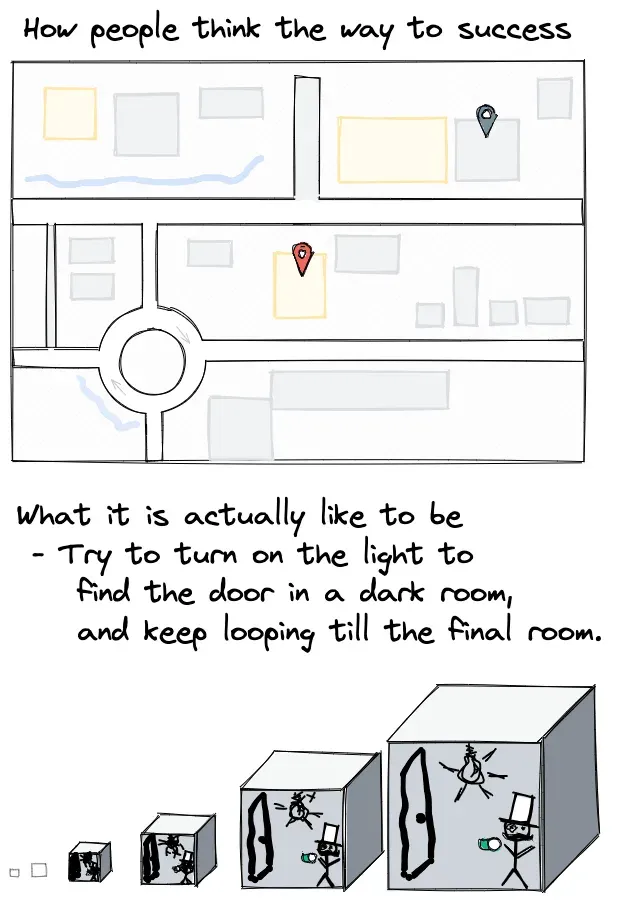
I drew a picture of this back in 2022, before I was thinking about global expansion at all. The top half shows how people imagine success: a map viewed from above, start point, destination, a clean navigation line. The bottom half shows how it actually feels: a person standing in a dark room, feeling around for the light switch. The light comes on, they finally see the door, they walk through it, and the next room is bigger and just as dark. It repeats.
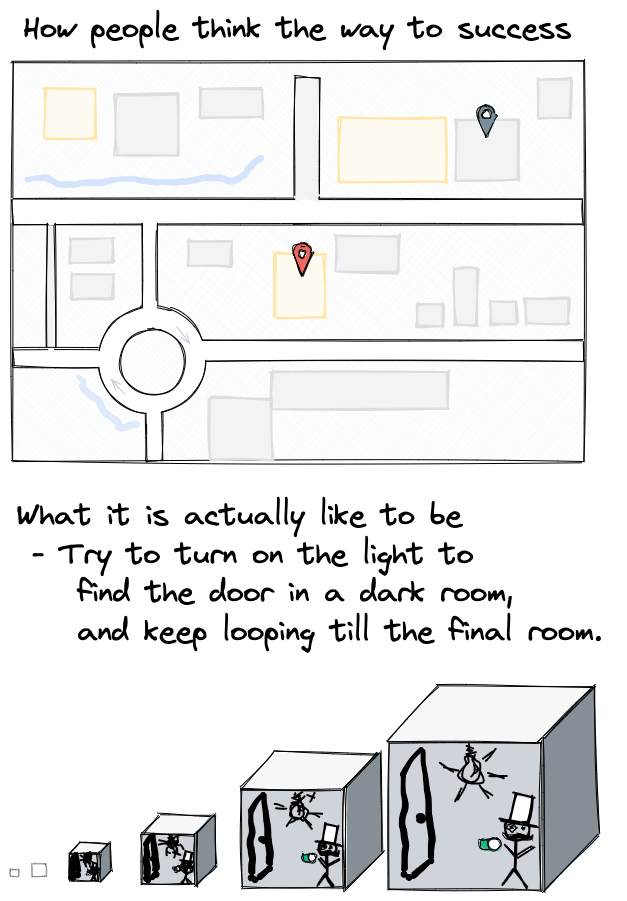
Look at overseas expansion through that picture and the sequence becomes clear: find the light switch first, then find the door.
Finding the switch means generating feedback at the lowest possible cost. Small test orders. One market before five. Testing trust signals separately instead of all at once. Money spent in this phase isn’t execution budget. It’s the price of information. Finding the door comes after the light is on: direction confirmed, then the scaled investment. The two phases spend different kinds of money at completely different tempos.
The most common way overseas expansion fails is mixing those two kinds of money: spending at door-finding scale while still doing switch-finding work. Half the annual budget gone in six months, and the postmortem concludes the playbook was fine, the market was just hard. What actually happened was sprinting at full speed inside a dark room.
There’s a harsher layer. Finding the switch is not a one-time event. When the first overseas market works, the instinct is to think: now we have the map. The US playbook gets copied to Europe. But cracking one market only means you walked out of one room. The next market, the next order of magnitude, is a bigger room, and the switch is somewhere else. The more successful the company, the harder it falls here, because its confidence in “having a map” was fed by the previous room.
So when I judge how mature a company’s global operation is, I no longer look at the playbook first. I look at whether they separate the two phases: in the dark, are they willing to spend small and book failures as the cost of information; once they see the door, are they willing to commit fast and big. Companies that make this distinction may show ugly numbers for six months, but every dollar is buying light. Companies that don’t show busy numbers, and when the money runs out, the room is still dark.
Adam Yang | 10+ years in China-to-global expansion. Former Greater China lead at Quora; previously gaming vertical, Greater China at Twitter. Newsletter: 出海子午谷